Conversation Data Concepts
A Conversation is any service engagement or event generated by the Conversation Platform and administered by the Virtual Agent; it can be a chat, a voice call or a Service Request. This page describes the basic concepts, entities, and processes concerning conversations.
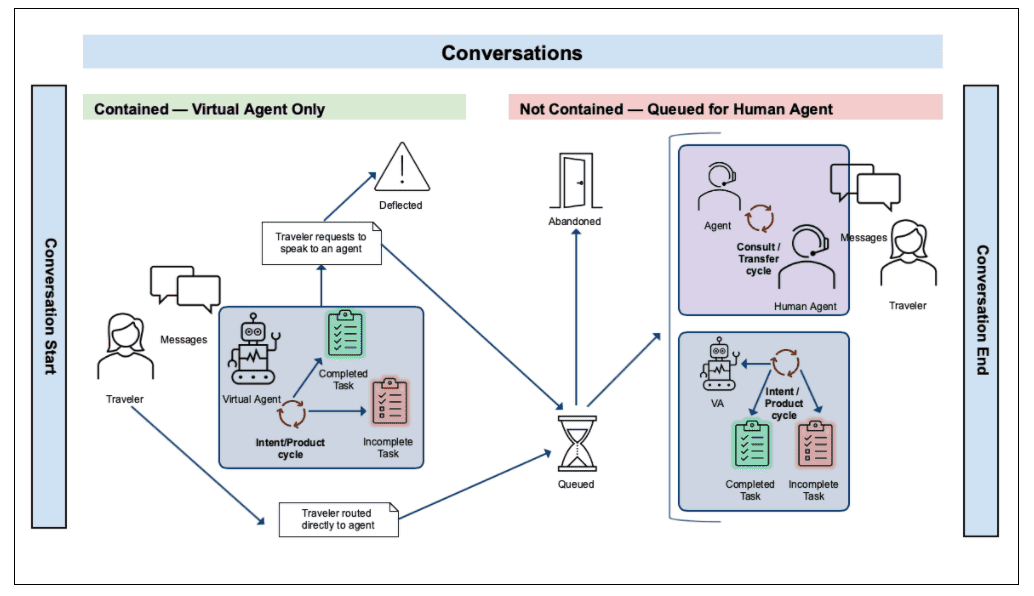
A conversation is initiated when travelers use the Conversation Platform to service their needs. The conversation can take place via online chat, voice call, or email service request. While using the platform in a text-based mode, such as chat, travelers can interact with a Virtual Agent (VA) by exchanging texts, called Messages. The VA is equipped with intelligent skills to determine and fulfill many customer intents. Each Skill is composed of specific Tasks to successfully accomplish the skill.
Containment
Conversations may be contained or not contained:
- Contained conversations are those that are fully serviced by a Virtual Agent.
- Not Contained conversations are at least partly serviced by a Human Agent.
A conversation can be Queued for routing and assignment to a Human Agent equipped to handle the customer's intent while matching their language, location, etc.
A Queued conversation is considered to be Not Contained. Similarly, a conversation in the queue may fail to be assigned to a Human Agent, effectively making the conversation Abandoned. This can happen due to several reasons, for example by system failure or because a traveler intentionally abandoned the conversation.
The Human Agent servicing the traveler also has the VA at its disposal, fully leveraging its intelligence to better serve the traveler. He can also Consult with or Transfer the conversation to another agent who is better equipped to serve the traveler.
Deflection
At any point during the conversation (whether the VA completes the skill or not), the traveler can request assistance from a human agent. If the attempt to transfer to a human agent fails, the conversation Deflected.
Deflection generally occurs in accordance with Business/Partner rules such as hours of operation (HOO), throttle rules, customer requests for email response, callback, or other offline options.
Channel filters
Conversations may be filtered by Channel Type and Channel Name as follows:
| Channel Type | Channel Name | Description |
|---|---|---|
| Chat | c3 | Chat conversations initiated by travelers via the VAC (Virtual Agent Control). |
| Chat | voyager_next | Chat conversations initiated by agents in Voyager Next. |
| lx_supplier | Email conversations initiated by suppliers and routed through the conversation platform to hide supplier’s email account details from Traveler. | |
| mailgun | Email conversations initiated by travelers and handled by the Mailgun Adapter. | |
| voyager_next | Email conversations initiated by agents in Voyager Next. | |
| voyager_next_email | Child email conversations initiated by agents in Voyager Next. | |
| Event | event_stream | Air Schedule Change notifications. |
| Offline | service_request | Service Requests created for agents to handle. For Conversation V1, the same Service Request will likely be handled across multiple conversations. |
| Voice | mcv | Chat conversations initiated by agents from MCV Softphone. Channel Type used to be "Chat". |
| Voice | voice_bridge | Voice conversations initiated by travelers from ICRS (off platform, but imported into platform data warehouse for reporting). |
| Voice | voice_bridge_smartphone | Voice conversations initiated by agents from ICRS (off platform, but imported into platform data warehouse for reporting). |
| Voice | phone | Voice conversations native to Conversation Platform. |
| Web | epcweb | Lodging relocation notices sent to travelers. |
Participant Session concepts
Formerly known as Conversation Segment, a Participant Session captures the details of each Participant, including the Virtual Agent, who initiated or joined the Conversation
Participant type
- Traveler
- TravelerVA
- HumanAgent
- HumanAgentVA
- Supplier
- SupplierVA
Participant events
- Invite – Participant requests to join the Conversation (N/A for 1st Participant and Traveler VA)
- Join – Participant joins the Conversation (First event for 1st Participant and Traveler VA)
- Leave – Participant leaves Conversation. It is possible for the same participant to rejoin the Conversation.
Key metrics
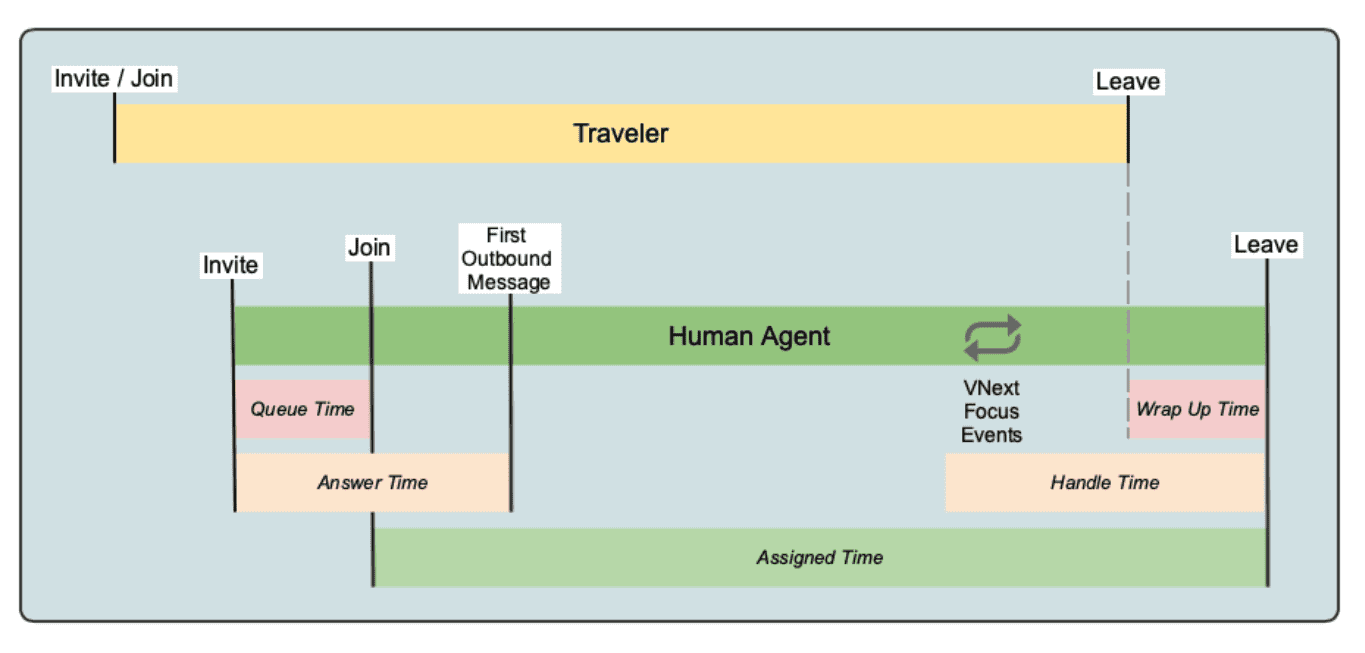
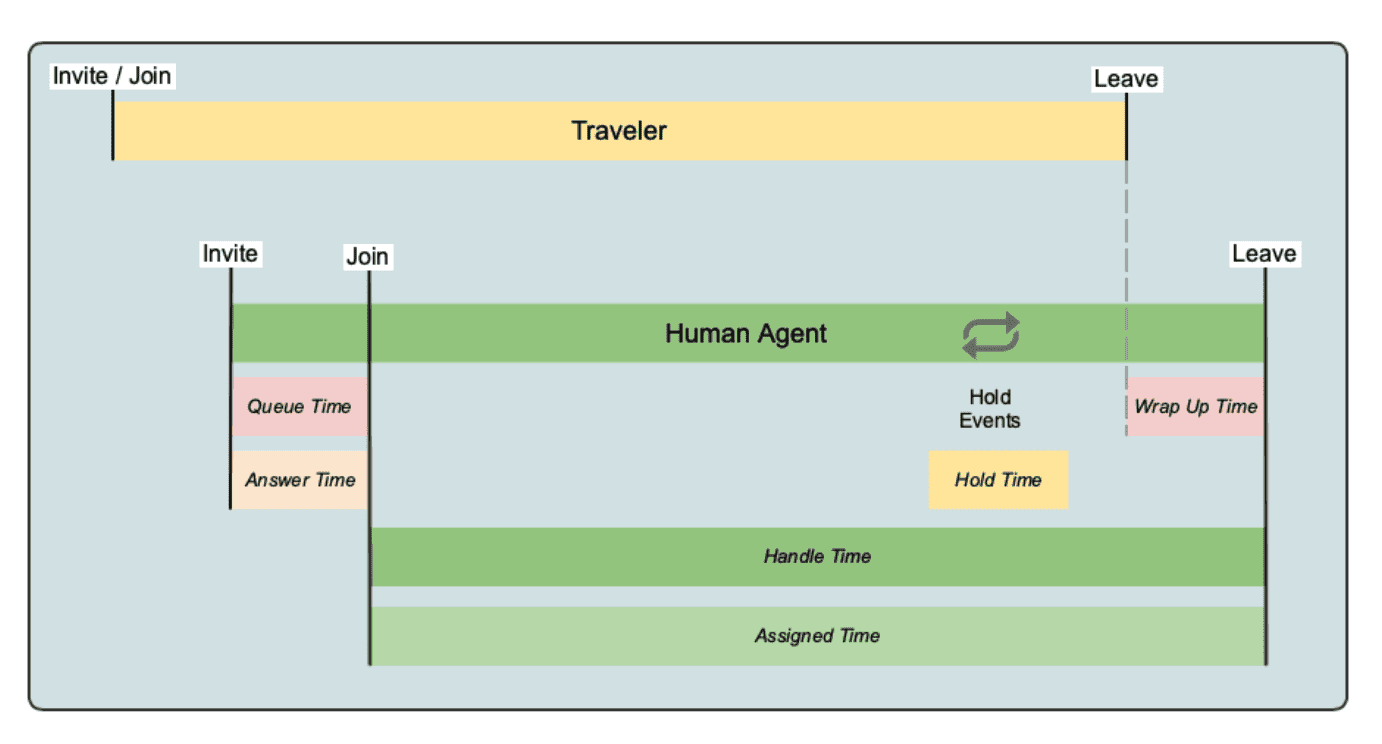
- Queue time
- Answer time
- Assigned time
- Handle Time
- Wrap-up time
Queue time
Total time in seconds that Conversation was in Queue waiting to be assigned to an Agent.
- Begins when the Human Agent is invited to the Conversation.
- Ends when the Human Agent joins the Conversation.
Answer time
Total time in seconds from when Conversation was placed in Queue and Agent's first response.
- Begins when the Human Agent is invited to the chat session.
- Ends when the Human Agent sends the first outbound message to the Traveler.
Assigned time
Total time in seconds that Conversation was assigned to an Agent.
- Begins when the Human Agent joins the Conversation.
- Ends when the Human Agent leaves the Conversation.
Handle time
Total time in seconds that Agent worked on the Conversation.
- Occurs whenever the Human Agent uses VNext to answer the Traveler's requests.
Wrap-up time
Total time in seconds that an Agent participant was in wrap-up.
- Begins when the Traveler leaves the Conversation.
- Ends when the Human Agent leaves the Conversation.
Chat example
Voice example
Summary Data Dictionary
For descriptions of the various data fields grouped by type, refer to the corresponding section: